
You buy good plywood, have it delivered, and leave it on site for a few days. Then you pick up a sheet and it’s bent like a banana, or the edges look puffy and the glue lines are starting to peel.
Quick Summary: UAE’s extreme heat, coastal humidity, and sudden temperature shifts cause plywood to warp, swell at the edges, and delaminate. You can easily prevent this damage by storing plywood indoors on flat wooden pallets, keeping it off the ground, using supports every 40 to 60 cm, and ensuring proper ventilation around covered stacks.
This is a very common problem across the UAE. Plywood is a strong material, but it reacts to its surroundings. Our climate—with high summer heat, humid coastal air, and sudden swings between hot outdoors and air-conditioned rooms—is tough on wood products.
The good news is that most of this damage is completely preventable. This comprehensive guide explains what the UAE climate does to plywood and how you can store it properly to protect your investment.
Why Plywood Reacts to Heat and Humidity
Plywood is manufactured by bonding thin layers of wood veneer together with adhesives. Because wood is a natural hygroscopic material (as explained in this Wood Science Research Guide), it continuously absorbs moisture from the air when it is humid and releases it when the air is dry.
In the UAE, this environmental fluctuation can happen repeatedly, sometimes within the same week. This constant expansion and contraction puts stress on the board structure.
What Heat and Humidity Do to Plywood
1. Warping and Bending
If one side of a plywood sheet absorbs more moisture or heat than the other, that specific side expands faster, causing the entire sheet to bend. This frequently happens when sheets are leaned against a wall at a steep angle or left flat with one face exposed to direct sunlight or damp flooring.
2. Swollen Edges
The raw edges of a plywood sheet soak up moisture much faster than its sealed faces. In humid coastal environments like Dubai, Sharjah, and Abu Dhabi, the edges swell and become rough or puffy.
3. Delamination
Delamination occurs when the inner adhesive bond fails, causing the layers to separate. Constant moisture changes or direct water contact severely weaken the glue lines. Once delamination starts, it is nearly impossible to repair, and the sheet usually has to be discarded.
4. Mould and Staining
Plywood left in damp, enclosed spaces can quickly develop mould or dark fungal stains. This is a common issue when sheets are stored in unventilated rooms or tightly wrapped in plastic while still damp.
5. Cracking and Dryness
In extreme summer heat, plywood stored in direct sunlight dries out too rapidly. The outer surfaces may crack, become brittle, and the top veneer layers can start lifting at the edges.
Does the Type of Plywood Matter?
Yes, absolutely. Choosing the right material grade makes a huge difference in the UAE climate:
- WBP Plywood: Manufactured with weather-resistant exterior glue designed to withstand high moisture. It is the safest choice for humid areas or outdoor-adjacent settings.
- Film-Faced Plywood: Features a waterproof phenolic coating on the surface, making it ideal for concrete formwork (popular options include Sveza and Sancoplex). Note: Exposed cut edges still require waterproofing sealant.
- Birch Plywood: Known for its tight, uniform grain and high structural stability. It holds up exceptionally well for high-end furniture and interior joinery when stored correctly.
- Standard Commercial Plywood: Cost-effective and great for indoor use, but requires much stricter storage control to prevent warping.
How to Store Plywood in the UAE: 8 Simple Rules
- Keep it indoors whenever possible: A covered, well-ventilated warehouse or site room is ideal. Avoid leaving sheets exposed to open sun, rain, or heavy sea breeze.
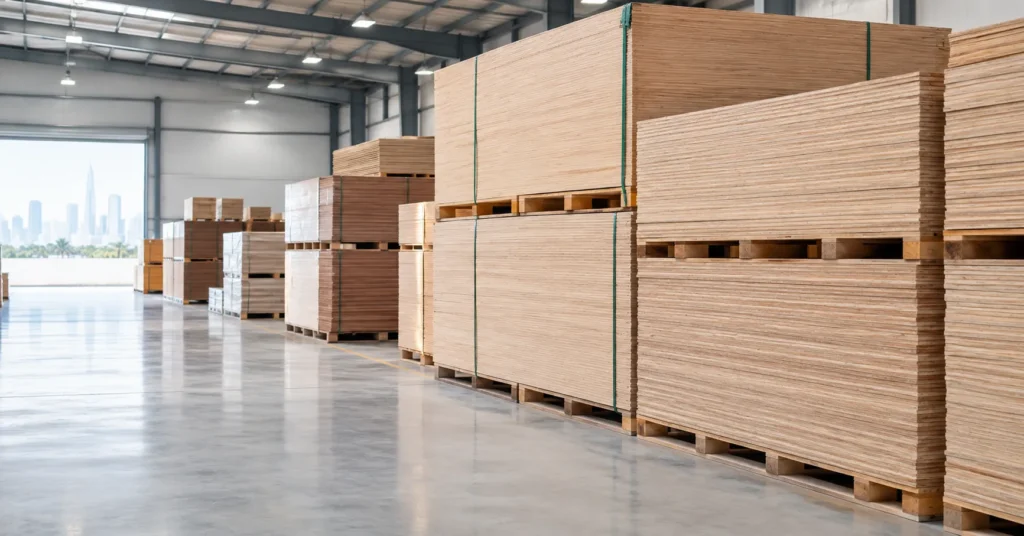
- Never place sheets directly on the ground: Concrete and tile floors absorb and release dampness. Always use wooden pallets or timber skids to lift your stacks off the ground.
- Store sheets completely flat: Lying flat distributes weight evenly and prevents the boards from bending. If storing upright is unavoidable, ensure they are fully supported without steep leaning angles.
- Use supports every 40 to 60 cm: Place evenly spaced bearers under the stack to prevent the sheets from sagging in the middle.
- Cover the stack, but let it breathe: Use a protective sheet to guard against dust and job-site splashes, but avoid airtight wrapping. Leave the sides slightly open for cross-ventilation.
- Keep away from direct sunlight and hot walls: Uneven heating causes rapid warping. Choose a shaded, temperature-stable storage zone.
- Let plywood acclimatize before installation: If moving panels from a hot outdoor container or storage yard into an air-conditioned room, give them 48 to 72 hours to settle to local ambient conditions.
- Protect the exposed edges: Apply a coat of edge sealer or exterior paint to cut edges to block fast moisture absorption.
Common Mistakes to Avoid
- Leaving sheets outside “just for a day or two” during peak humidity.
- Stacking heavy, uneven items on top of a single loose sheet.
- Storing timber next to active wet zones, washing areas, or leaking pipes.
- Installing plywood immediately after transit in a hot delivery truck.
- Wrapping sheets tightly in plastic sheeting while they contain residual moisture.
Quick Checklist Before Installation
Before you store or install your panels, verify these points:
- Is the stack elevated off the ground?
- Are the sheets lying flat and fully supported?
- Are they completely protected from direct sun and rain?
- Is air circulating freely around the stack?
- Are all cut edges sealed?
- Has the plywood been given time to acclimatize?
If the answer to all six is yes, your material is ready for a successful installation.
Final Thoughts
Plywood and the UAE climate do not have to be a mismatch. By understanding material behavior, selecting the correct structural grade, and following proper storage protocols, you save valuable time, budget, and material wastage.
At Sanco Building Materials, we supply premium WBP, film-faced, birch, and commercial plywood across various thicknesses, backed by reliable site delivery all over the UAE. Not sure which grade fits your project specifications? Check out our Contact Page to speak with our expert team for professional advice and a customized quote, or explore our full range on the Sanco Shop.
Frequently Asked Questions
Short-term storage outside is possible only if it is heavily covered, kept strictly off the ground, and shielded from direct sun. However, indoor storage is always recommended.
Allowing 2 to 3 days in the exact room or environment where it will be installed is the ideal rule of thumb.
WBP (Weather and Boil Proof) plywood is the safest and most durable choice for high-moisture applications.